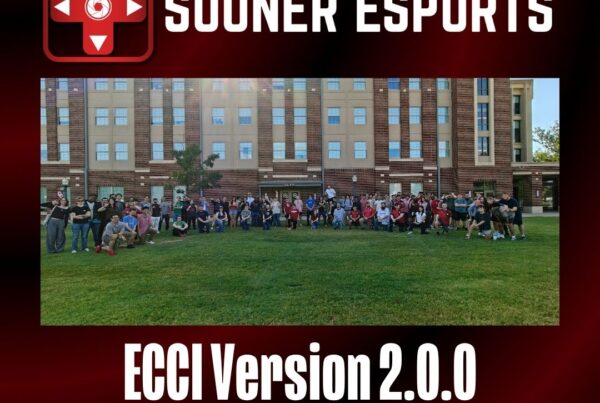

On Saturday, November 8th, the OU Esports & Co-Curricular Innovation Alumni Advisory Board held a workshop for student leaders within the organization. The attendees represented the best of OU ECCI—all coordinators and leads from Community & Labs, Media & News, and Competition.
This conference would not have been possible without the hard work and dedication of the Alumni Advisory Board members Anita Ly, Charlie Crum, Lorenzo Rocchi, Meghan Warren, and Kelly Berry.
The workshop was held over a three-hour period, during which participants cycled through hands-on activities and discussion topics. There were also two guest speakers: Joshua Riesenberg, OU ECCI Competition Coordinator and Ph.D. student, and Dr. Wil Fisackerly, lecturer of sports business at the OU Price College of Business and Sports and Business Advisor for the OU ECCI Research Committee. Many Alumni Advisory Board members also shared their insights during the speakers’ presentations.
Charlie Crum, a founding member of the Alumni Advisory Board, explained what initially piqued his interest in the Board.
“When Anita [Ly] started the Board, I applied so that I could give back to OU with my time,” he said. “In particular, the experiences I’ve gained through gaming helped me develop some of my most valuable professional skills, and I wanted to use that insight to help OU ECCI students draw on their gaming experiences to highlight their own valuable skills.”
Crum noted that the board played an active role in the workshop. He said, “Four Board members shared moments of success and of missed opportunities from their own careers, putting into focus how the leadership skills the students [learn] will serve them long past their time at OU.”

Fisackerly and Riesenberg’s presentations focused on developing those leadership skills that Board members used to see success after college. The presentations focused on defining effective leadership, communication within a team, and delegation.
Fisackerly said that his goal going into the conference was “to [teach] them the basics of understanding what collegiate esports looks like across the country…from a leadership perspective, particularly in terms of building team culture and delegating.” He noted that the esports industry generally struggles with those aspects of leadership.
A highlight of Fisackerly’s presentation was a group activity involving building LEGO sets.

“At first,” Fisackerly said, “they weren’t allowed to discuss with each other, and there was only one person that had the instructions, so it was very hard for them to complete the set in time.”
After the difficult first round, Fisackerly let the students collaborate. “There was still a leader,” he said, “but they were able to get so much more done because of the fact that…there was still one person that had the vision for what they wanted to do, but everybody was a part of that process.”
After the activity, Fisackerly spoke to the students about the meaning behind the LEGO activity. “When we are building team culture, there is importance to having that hierarchy and having responsibility. But if you don’t let others take agency in the work you are doing, you are not going to have the capacity to achieve what you want to achieve.”
“The main thing I wanted to instill into them,” Fisackerly concluded, “is that we often think that the work we do is the most important part, but in reality, it’s the culture in which we inhabit that gives us the ability to do good work.”

Riesenberg’s presentation featured a group discussion between the attendees about how to improve repeated process communication. According to Riesenberg, repeated processes in a game might be a code word for a specific maneuver, whereas repeated processes in real life might look like scheduling consistent practice times or team meetings.
“What’s something you can turn into a repeatable process?” Riesenberg posed to the group. Expecting a typical, one-on-one interaction with each of the participants, he was pleasantly surprised to see the burgeoning leaders turn to discuss strategies with each other.
“…[This] was really good,” Riesenberg said. “[The activity] turned less into a repeated one-on-one with me…and more [into] a group discussion. Even the alumni got in to say…[what] works in real-world office scenarios.” Riesenberg laughed, admitting that the excellent collaboration between teams meant his presentation ran half an hour long, but he explained that holding these kinds of discussions was the entire point of the conference.
Overall, workshop attendees enjoyed the experience and look forward to participating in future workshops.
“The workshop was so much fun,” OU ECCI Marketing Coordinator, Bee Cary, shared. “[The presenters] both did an excellent job at covering the basics of leadership, what it takes to be a leader, what it means to continue to hold leadership, and how you need to stress your strengths and develop your weaknesses.”
Cary connected the workshop’s advice to a recent change in OU ECCI. They explained that one of their colleagues was encouraged to take a leadership position within OU ECCI, even though they had never been in a leadership position in the past.
“Even if you’ve never been a leader before,” Cary said, “That doesn’t mean [you can’t] be a good leader, you just have to know [how] to find your footing.”
Veer Malik, Captain of the Rainbow Six Siege team, said, “I was told that lots of people do [esports] in college, and they don’t know how this transfers to real life. And I’m definitely in that boat.”
“All the people [at the workshop] were people who’ve previously been in OU Esports or [the OU] Gaming Club and now have real jobs outside. They’re…trying to draw connections and examples from how this stuff that we do now can be applied to stuff later,” Malik explained.
“I hope that the workshop continues every semester for future generations of leaders within OU ECCI,” Garret Merryman, Assistant Coach of the Apex Legends team, said. “Being able to teach younger people how to be leaders is very beneficial because they…will be the ones leading after we’re long gone from the program.”
The leadership conference from the Alumni Advisory Board was a great success and helped to develop leadership skills and strategies in many OU ECCI members. Through fun demonstrations, engaging presentations, and a welcoming community, the leadership workshop is something that all OU ECCI leaders can look forward to in the future.