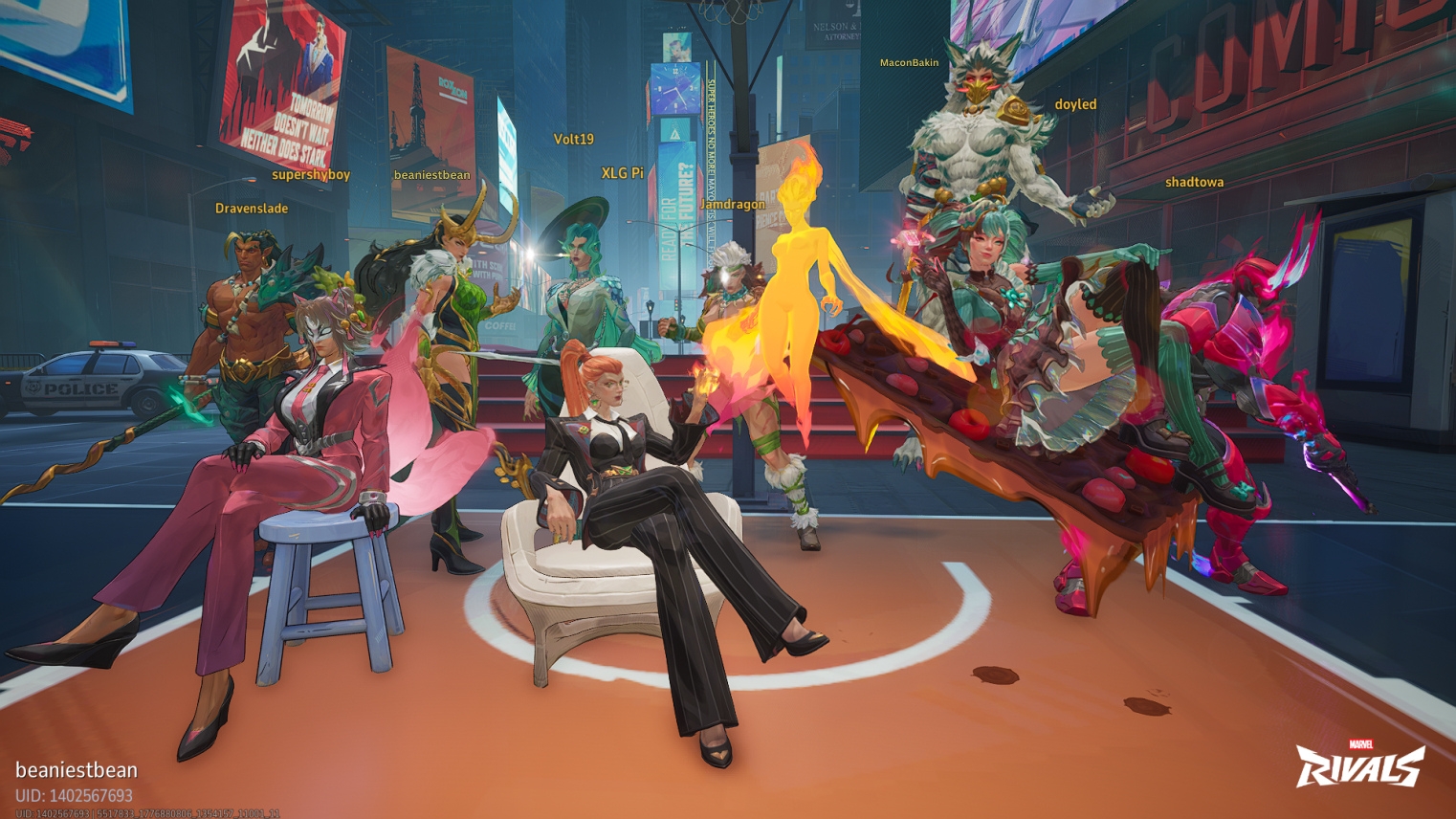
On Wednesday, April 22nd, 2026, after a long and hard-fought bracket, the OU Esports “Marvel Rivals” A Team took victory in the ECAC Division B finals against the State University of New York Polytechnic Institute, also known as SUNY Poly Blue.
This victory marked the first time the “Rivals” team has won a championship in two semesters of play. The team demonstrated explosive growth from its creation in Fall 2025, and the members are incredibly proud of their performance.
I interviewed half of the team, as well as the coach, Devan “Dravenslade” Wright, on how they felt about the spring ECAC season and the academic year as a whole. “Marvel Rivals” competitive play has changed and grown significantly over the course of the year, as has the team.
The Fall 2025 season wasn’t as successful as the Spring 2026 season for a variety of factors, including building up a brand-new team and learning a new game, which came out in December of 2024.
“It was hard in the fall semester, I think, because we were all getting used to each other,” said Lena “doyled” Kang, a freshman and Strategist main.
Some team members were esports veterans who had to figure out the new game, while others were simply trying to improve upon the skills they’d already developed for competitive play.
“I was definitely figuring out my role as a player,” Jordan “MaconBakin” Bacon, a Vanguard main, said. “After the (fall) season was over, Bryson, who was on the team last semester, said ‘pick a character who you want to play and get really damn good at that character.’”
One of the driving factors in recruitment for “Rivals” was that OU Esports’ “Overwatch” team did not return in Fall 2025 due to a lack of interest. Kang, who had originally wanted to join the “Overwatch” team, and Wright, who was the coach in previous years, pivoted to “Rivals.”
“I did apply in the fall to be on the Overwatch team, but that fell through, and either way, that was good for me, because I wanted to be a Marvel Rivals player first,” Kang said.

Kang enjoys the chaotic visual “clutter” that comes with playing hero shooters, particularly “Rivals.” Wright, meanwhile, has loved coaching esports titles.
“Before I coached Marvel Rivals, I coached Overwatch, and that was my bread and butter,” Wright said. “Now all of a sudden we have Marvel Rivals, a brand new game, and there’s so much to learn.”
Wright faced burnout with the “Overwatch” title. He loved the energy that came with “Rivals,” and he loved learning the game alongside his players. The pick and ban system in competitive play was a challenge for him to learn, but by the Spring, he and the rest of his team had figured it out and utilized it well.
The “Rivals” team has been able to grow explosively from Fall 2025 to Spring 2026.
Riley “XLG Pi” Anderson, a senior Duelist main, is a new addition to the team as of the spring and was previously a “VALORANT” esports player.
“I picked (Rivals) up in the last week of the fall semester during finals and then played throughout December,” Anderson said. “Going back to a competitive environment with a structured team and players that you know is a lot of fun.”
“VALORANT” is a very different experience compared to “Rivals,” but Anderson found that he preferred “Rivals” esports.
“VALORANT is interesting because the game presents itself as competitive, whereas Marvel Rivals presents itself as a game for having fun,” Anderson said.
He ended up with burnout after playing so much competitive “VALORANT” and gladly made the switch.
“It adds up when you die in “VALORANT.” You’re sitting there with your mistakes for a minute or two at a time.”
His presence helped the team solidify their compositions and strategies in matches. “Rivals” was a new game for him, but his experience in “VALORANT” helped him catch up fast and learn to work with a new team.

“At the beginning of the semester, I was very limited in my hero pool,” Anderson said. “We had to craft our picks and bans around making sure that I had a character that I could play on any level.”
Anderson wasn’t the only one who improved over the semester, though. Kang’s skill as the character Gambit propelled her into the top 60 Gambit players overall. Gambit would often get banned in competitive matches due to both his meta nature and Kang’s skill.
“I’m always going to be stuck playing Gambit,” Kang said. “I started in the fall as the Luna player, and I would play all the time.”

Kang did enjoy the feeling of getting to play a round as Gambit before the enemy team would wise up and ban him. Anderson had a similar experience with many of his characters.
“It’s kind of an ego boost because they’re scared of me,” Anderson said. “I know we’ve already won the match at that point because I can play other characters, and they’re leaving things open that the rest of my team is going to be able to carry. Every single person on the team is able to be our win condition.”
Anderson, who plays hitscan characters such as Elsa Bloodstone, Phoenix and The Punisher, picked up Psylocke late in the season to throw opposing teams off. Psylocke is a close-range flanker, while Anderson’s other picks are longer-range characters.
On top of growing skills as players, the “Rivals” team had to adapt to changes to the in-game meta. Seasons in “Rivals” only last a month, and with each new month comes a new character, as well as buffs and nerfs for the established roster.
“You have to constantly be adapting,” Bacon said. “That’s something I can thank our coach Devan a lot for, because without him, I would still be playing either Strange or Captain America and not have learned people that I feel more comfortable playing now.”
“Sometimes we have to be more cautious,” Kang said. “A lot of the changes affect more DPS, and the tanks, but that’s in my favor.”
“The Captain America changes were difficult,” Bacon said concerning a recent nerf to Captain America’s kit. “I still haven’t fully adapted.”
He has supplemented his discomfort by learning how to play other Vanguard heroes such as Angela. His Angela gameplay has proven to be quite effective late in the spring season due to her ability to displace other heroes.
The team has also refined strategies and plays in each game. Their dive composition has proven quite effective, thanks in part to Bryce “Shadtowa” Stanberry, a Duelist main who provides callouts of enemy positions to his teammates.
“We have struggled with dive in the past,” Bacon said. “I think we only figured it out in the past two months or so. We have to dive together and at once, and it’s difficult.”
Over the course of the Spring 2026 semester, the team has kept up with the constant meta changes and excelled in ECAC Division B. They won against the majority of their opponents and even won in a huge upset against Kaiser University, which was the top seed in the playoff tournament.
“We fully acknowledged that this was an undefeated team,” Wright said regarding Kaiser. “We knew what we were signing up for. Initially, it was looking like it was going to be a sweep. I’m sure all of us were surprised when it came down to the wire. My team just knew what to do. They were confident, they kept their cool, and they used the tools that I’ve given them over the season.”
Despite Kaiser’s reputation as being undefeated, the “Rivals” team at OU Esports refused to be intimidated. They moved through the tournament to the finals without a loss.
The finals match against SUNY Poly Blue was a rematch for OU Esports, which had won a match against them much earlier in the season. While the first round of the finals match was a loss, OU Esports quickly pulled around and won the next three rounds to take the victory for the best-of-five match.
The team’s start in Fall 2025 was rocky because there was so much to figure out with a brand-new title. The team put in a lot of work to reach the skill level they were at by the end of the spring season.
“It’s paid off a lot, because a lot of the things I was trying to implement with the team in the Fall were a struggle,” Wright said. “We have a new roster of players who have never competed on a team before.”
“Once I saw the light bulbs start to come on, the synergies started to click in the spring,” he said. “It was really rewarding as a coach because they started to understand, ‘oh, this is how I need to be doing things and communicating with my team.’”
Wright has been incredibly happy with his team’s performance and growth this past academic season. While coaching for “Rivals” has been a new experience, he’s enjoyed it more than his time with “Overwatch.”

“I was interested in Rivals even before I knew that the Overwatch team wasn’t continuing this academic year,” he said. “I didn’t know what capacity I wanted to pursue it in, but I knew I had an interest.”
His coaching skills have paid off, but he attributes the team’s success to their adaptability, positive vibes and good work ethic, which he said was a “night and day difference” compared to “Overwatch.”
“They are so good at communicating and working well with each other,” he said. ‘They were very capable of adapting. No matter what was thrown at them, they were able to see things from a different angle. As a coach, it was simple for me to guide them.”
Wright also made sure to shout out the “Marvel Rivals” B team at OU Esports, which also had a great spring season, ending up in third place during playoffs and making it to the first round of Nationals in NECC. He’s incredibly proud of both teams and all the members within them.
Having a good community and good attitudes was a large factor in creating such a powerful team, and the members of “Marvel Rivals” know it.
“There’s always going to be that healthy, happy feeling going around because we like each other,” Kang said. “I’m always excited to hang out with (the team).”
“The chemistry is definitely there,” Anderson said. “Playing ranked with your teammates helps so that whenever it comes to matches, you know the plays you can do as a duo or trio.”
While the “Rivals” team is the ECAC Division B champions, many of the members are less than pleased with the division’s management, communication and moderation practices.
“I want to win another state title, but in a league that actually matters,” Bacon said. “NECC was much more moderated than ECAC was. The teams that we participated with were much more well-mannered.”

Bacon did not like the toxicity present in ECAC, and he is excited to move back into the NECC league in Fall 2026, which was the same league the team participated in during Fall 2025. Anderson was neutral toward the issues that plagued ECAC.
“I enjoyed playing in the league and winning,” Anderson said. “The things that happened in-game don’t bother me too much because I try to keep a level head.”
Wright has expressed an optimistic viewpoint for ECAC’s future, however.
“It’s different whenever you’re a leader, because not only are you representing a team, you’re representing esports as a culture,” Wright explained. “You have to be real in these situations, because if we want esports to progress to a place where we can see it as commonly as we can traditional sports, get supported.”
ECAC standards weren’t consistently upheld, and Wright said that it was up to players to understand and enforce division rules. They also had to report any rule-breaking in the league. Toxicity in many teams was also enabled, and there were many miscommunications at the administrative level.
“My hope is that ECAC will learn from these things and will grow, because genuinely, I want them to succeed,” Wright said.
Members of the “Rivals” A team have expressed their gratitude for near-constant coverage of matches by the OU ECCI Production Team, which streamed most of the official matches from both the A and B teams. It has allowed the players to let their friends and family watch them play.
“My brother watches the streams, and he always texts me congratulations, or something like that,” Kang said.
“I try not to think about it because it’s kind of stressful, at times,” Bacon said. “But knowing that is nice because I send the stream to my friends and family right before it happens, and just knowing that they’re supporting me is helpful.”
“The streams have been amazing,” Wright said. “What we’ve been doing wouldn’t have been nearly as impactful and motivating without the streams to show everybody. It’s given (the Rivals team) a spotlight.”

The “Rivals” team has accumulated a community around the game, both within ECCI and from friends, family, and fans. The members are grateful to have so many people supporting them.
“(ECCI is) a lot more than I thought there would be, and I made a ton of friends,” Kang said.
Wright also attributes much of the growing community and fan support to fundraising and donations.
“We have such a good support base, and it’s growing,” Wright said. “We’re growing a fanbase, and I can attribute a lot of that to the support of the donors.”
The “Rivals” team is excited for what’s in store in Fall 2026 and beyond as the game and the team grow. Many of the current members want to continue playing next year.
“I definitely want to continue being part of the team, but I also want to hit at least eternity next semester,” Bacon said.
“I’d like to come back to “Rivals” in the fall semester,” Anderson said. “I’m just going to want to play my game, click some heads, and play with friends.”
“I’m looking forward to playing in NECC because that was really challenging,” Kang said. “I’m really excited. I think the team will get better and better.”
“I think we have a very bright future ahead of us,” Wright said. “I think we’re about to see something pretty monumental on the horizon.”
If you want to see OU Esports “Marvel Rivals” evolve, tune into their matches in August 2026 to see what happens. This team has had monumental success as division champions, and they are excited to keep their energy high next fall.